April 6, 2025 : What's Truly in My Heart
© 安岡喜晴 (JoyShine)
Today I'm going to go to Hirano Shrine to see the cherry blossoms.
We met at my place first, then hopped on our bikes and headed to a nearby cafe for a break.
At the cafe, we had to wait in the garden for a while until a table opened up.
These look so funny and adorable. Kind of like cotton candy?
I wonder what's inside. I'm kind of excited.
 |
 |
 |
On the card that came with the sweets, there was a waka poem.
Kachoka : "Minahito no hana ya cho ya to isogu hi mo waga kokoro o ba kimi zo shirikeru"
This means, "While the world is busy chasing flowers and butterflies, you alone understand what's truly in my heart."
Next, we went to the Kyoto Prefectural Government Office to see the cherry blossoms.
Whenever I come here, I remember the days when I visited this place for medical checkups for the staff working here.
Now that I am the deputy director of a comprehensive health checkup clinic, I no longer do that work, but this place always reminds me of those days.
I did not like that work at the time, since it was hard work, but somehow it feels nostalgic when I look back now.
After it is over, the memories turn into good old ones.
After it ends, the experience gains meaning.
The world is shaped between them: things that fade away into oblivion, and things that come to hold meaning.
Next, we visited the Seimei Shrine.
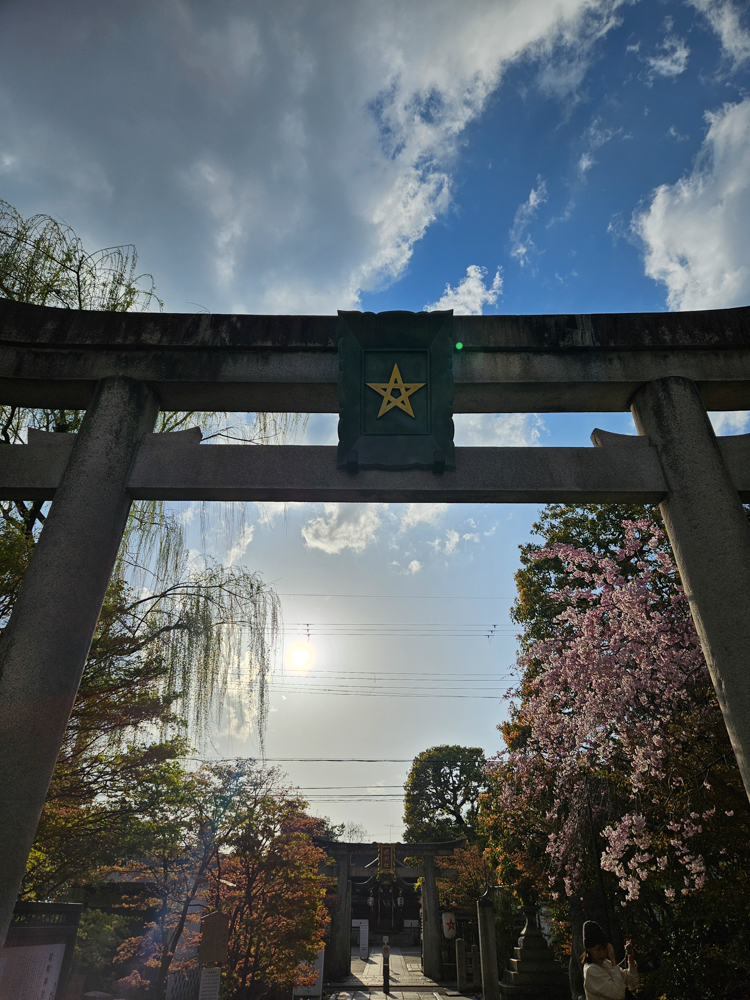
As I entered the grounds of Seimei Shrine, the grounds were totally quiet.
The pentagram showed its presence, as if it were watching over the footsteps of visitors.
The water simply flowed here, and the water basin was carved with a pentagram, and was filled with water.
I felt that this place had not changed since ancient times.
Giving names and receiving names are customs that have remained unchanged since then, as if names had been waiting before people arrived here.
Perhaps that is what names are: marks that tie invisible things to the world.
Sakura trees must have been blossoming before they were given their names.
Still, people gave them their names and tried to share their beauty with others.
When they were given their names, they first became "sakura trees."
People who tried to see invisible things had come here, and their prayers and questions had accumulated in this place, and I felt that they were still alive here.
Next, we went to Hirano Shrine.
There were many people who seemed to have come here to see the cherry blossoms.
Standing there and looking up, the sakura trees were in full bloom, as if they were covering the sky.
Even the gaps between branches were filled with pink colors, and only the blue sky was peeking through the tiniest openings.
Sakura trees are so beautiful, probably because they do not bloom forever.
They look as if they themselves know that they are not eternal.

Sakura trees are so beloved, probably because they accept that they are not eternal.
They look as if they themselves know this, because this very moment turns precious.
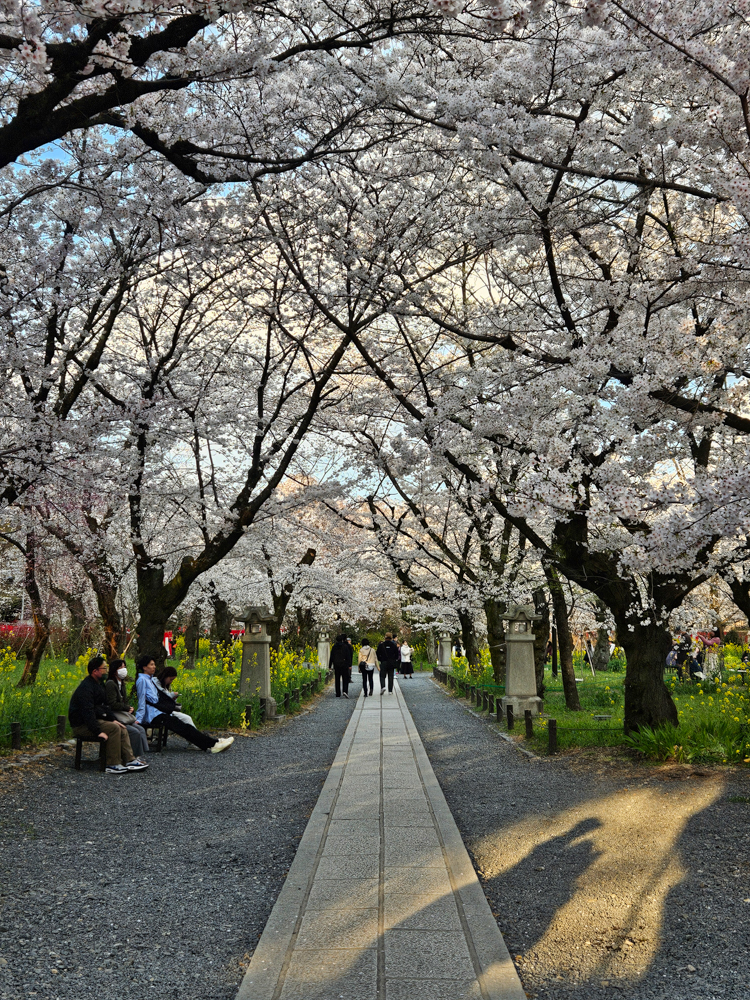
Sakura trees do not say anything, they just bloom and fall.
Still, the human mind tries to find words within them.
I think it is because sakura trees tell us the essence of life gently, quietly, and truthfully.
Next, we decided to spend some time until nightfall to see the cherry blossoms at night,
and during that time, we spent time at a nearby Korean restaurant.

The sakura trees at Hirano Shrine showed us a different expression at night.
Under the soft light, the white petals looked as if they were taking on subtle golden colors.
That was not gorgeousness, but stillness, as if time itself had shaped its appearance.
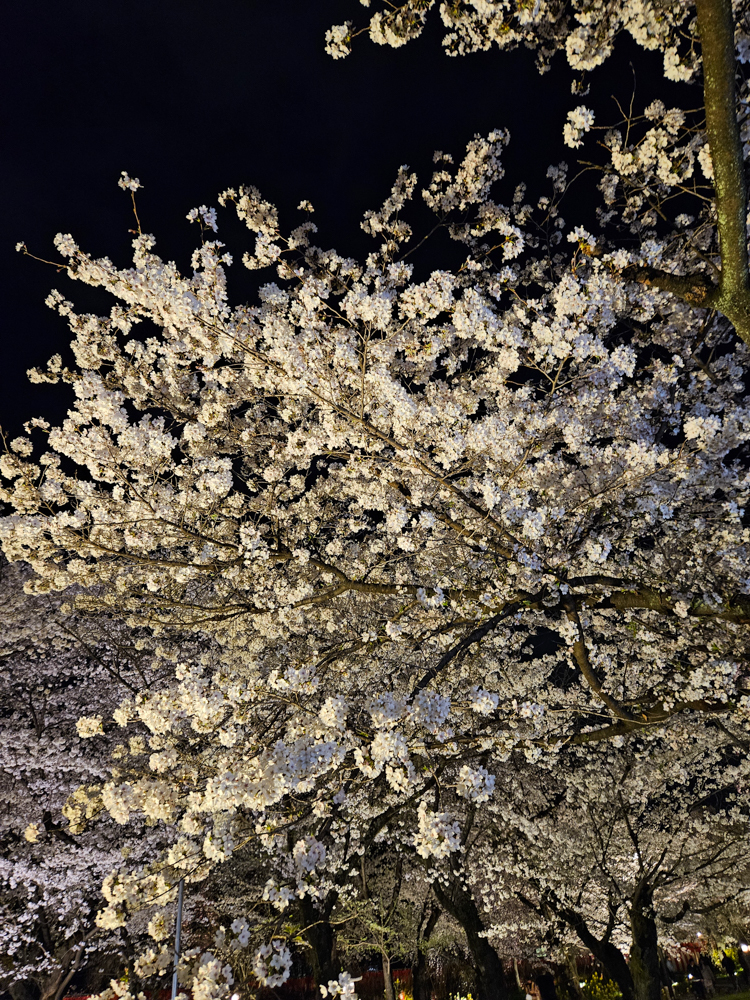
If sakura trees during the day represent "Spring," sakura trees at night represent "Time."

During the daytime, its gorgeousness stands out, and during the nighttime, its stillness attracts us.
I felt that this is the very aspect of human life itself.
When we are young, our youthfulness sparkles, and when we are old, our stillness, coming from experience, attracts people.
Sakura trees during the day and night, and human life during youth and old age.
Nature may look apart, but in its depths, everything is connected.
This is one example of the continuous aspects of nature.
Next, we went to the Kyoto Botanical Garden.
Inside the garden, lights were placed at regular intervals, and the sound of a fountain disrupted the silence of the night, while the path continued ahead.

The tulips were neatly arranged. They did not cover the sky like sakura trees, they simply indicated the colors of the season.
The sakura trees were in full bloom here, as well.

But they were different from the ones at Hirano Shrine.
Each has its own identity, and blooms in a managed space.

They bloom in nature, and are placed under management as well, and that produces stability.
Walking under the drooping sakura trees, I looked up at the sky and saw the floating moon among the blossoms.
I always remember that moment when I see the moon.
When I was around two years old, while taking a bath with my grandmother on the balcony, I saw, beyond the railing, the moon shining brightly.
I have seen many magnificent scenes, but still, that remains the simplest, most modest, and most beautiful scene so far.
I think that now, I am watching the same moon.
People see, know, and learn many things, but what stays forever in the mind is the light that needs no explanation.
The path beneath our feet continues, and time never stops.
The thing that has changed is myself, the moon never changes, and it still remains as an existence looked up at by people.
Like at that time, we can still look up at the moon.
This is why people look up at the moon, I came to think.
I had been wondering why people look up at the moon.
In that question, I felt that I somehow found one answer.
We can look up at the moon now, just as we could at that time, so we look up at the moon.

Time does not stop, nor is it rushed here.
The time I remembered at Hirano Shrine, slowly started to flow along the path.

Both starting to pause and starting to move are allowed on this night.

That very sense was proof that we are alive.